
7 steps · 4 parts · 2 roles
The report a parent gets, and where every number on it comes from
A weekly summary a parent can act on: what their child wrote, the mistakes that keep coming back, and which way the marks are going — built from exactly the same marked work the centre sees.
Everything below is the real product, photographed automatically. The school, its staff and its pupils are invented for this walkthrough — no real family appears on this page.
Sunday morning, one screen
Steps 1–2Parent- penleap.com/parentSigned in as Parent
1One card per child, and the same four figures for each 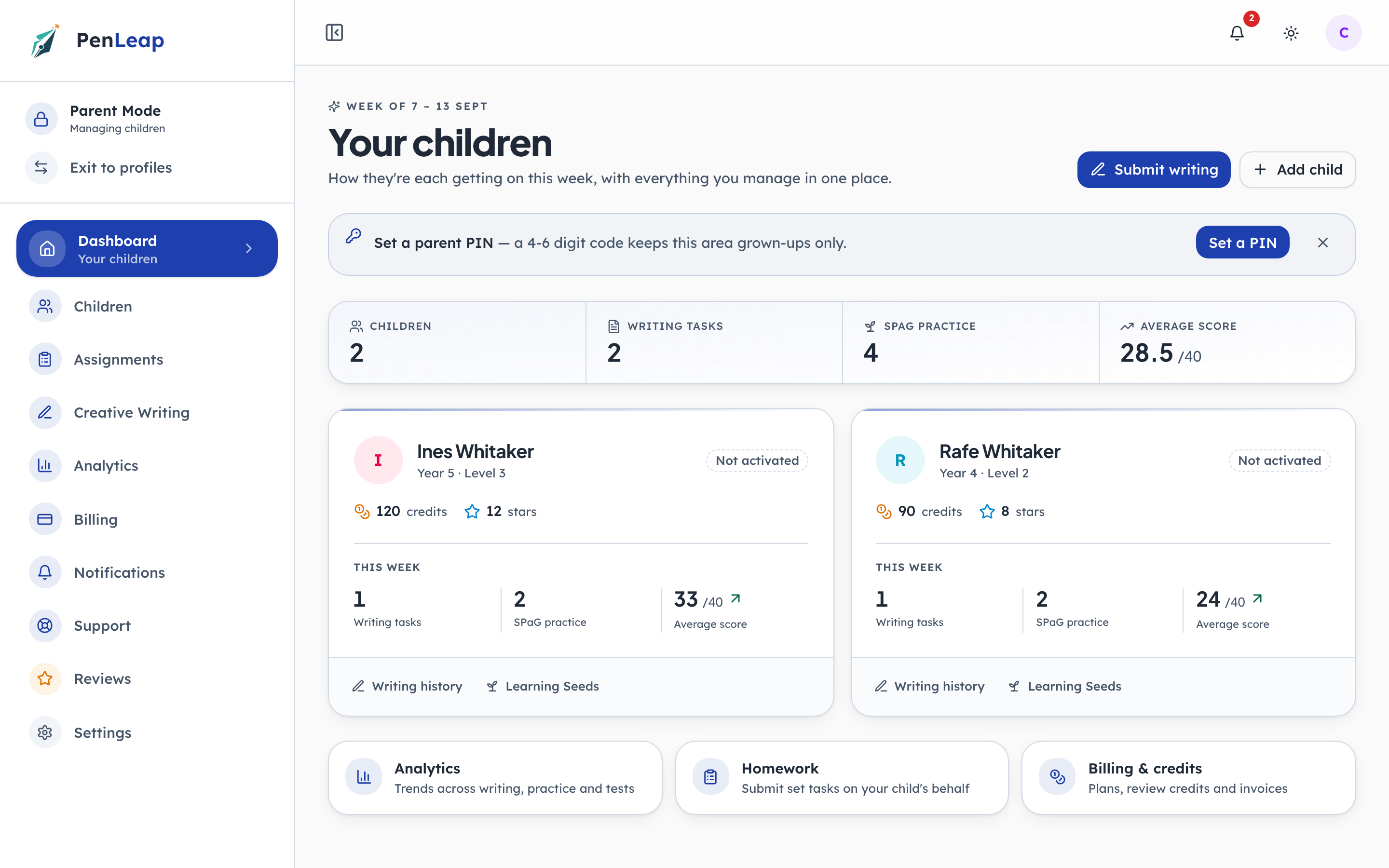
- 1Notice: Monday to Sunday, every week
- 2Notice: One card per child
- 3Notice: Across the family, this week
The date at the top is not decoration: this is a Monday-to-Sunday week, not a rolling seven days. That matters more than it sounds. A fixed week means the report a parent reads this Sunday can be compared with the one they read last Sunday; a rolling window silently makes every comparison meaningless.
- penleap.com/parentSigned in as Parent
2What they did this week — and which way it moved 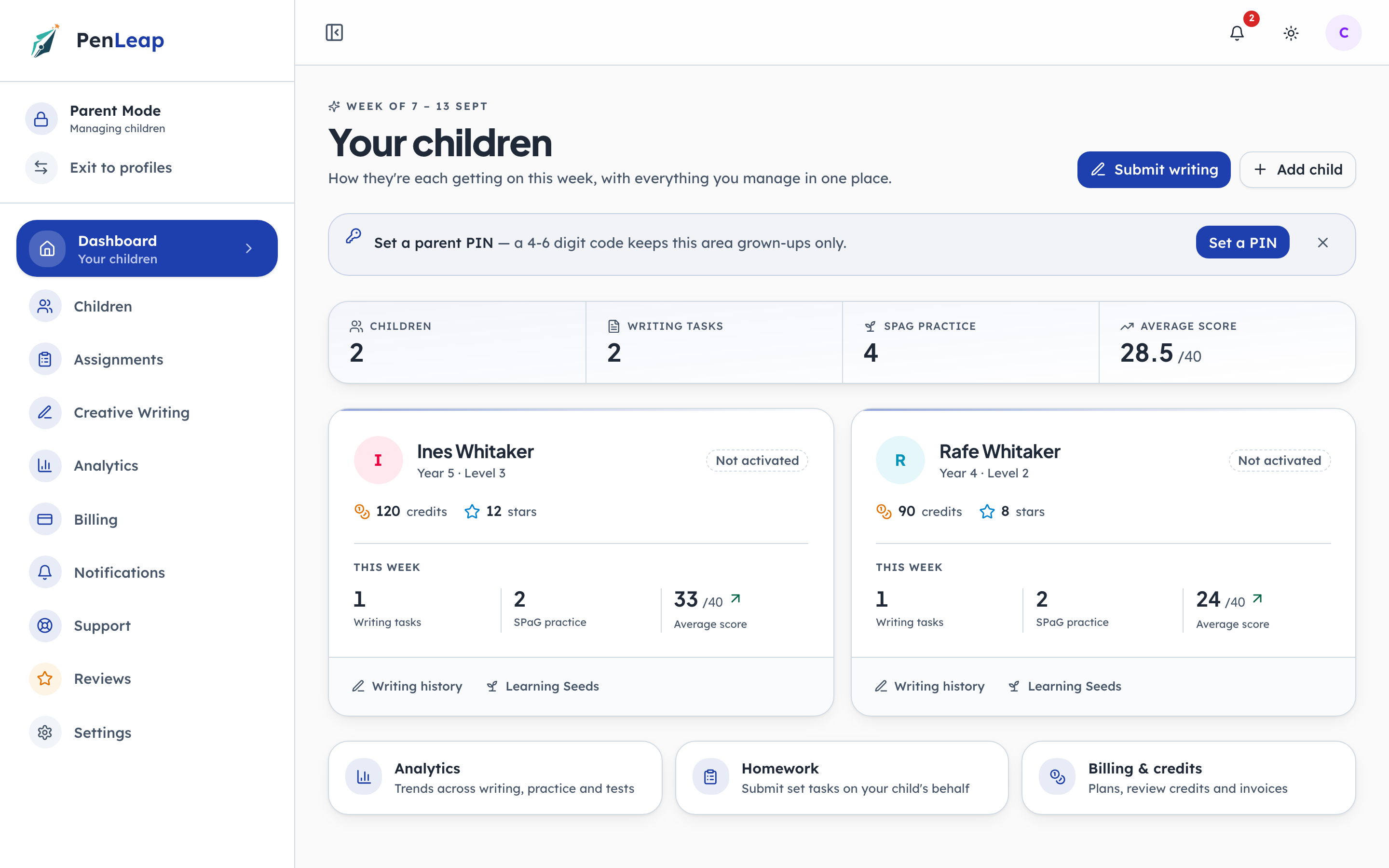
- 1Notice: The fixed week again
- 2Notice: Against last week
- 3Click: Down to the actual pieces
Writing tasks, practice, and the average, with an arrow against last week. The arrow is the part a parent reads first and it is the part that is hardest to fake: it compares two fixed weeks of marked work, so it cannot be nudged by a child logging in more often.
- penleap.com/parentSigned in as Parent
V1A quiet week says so, rather than inventing something 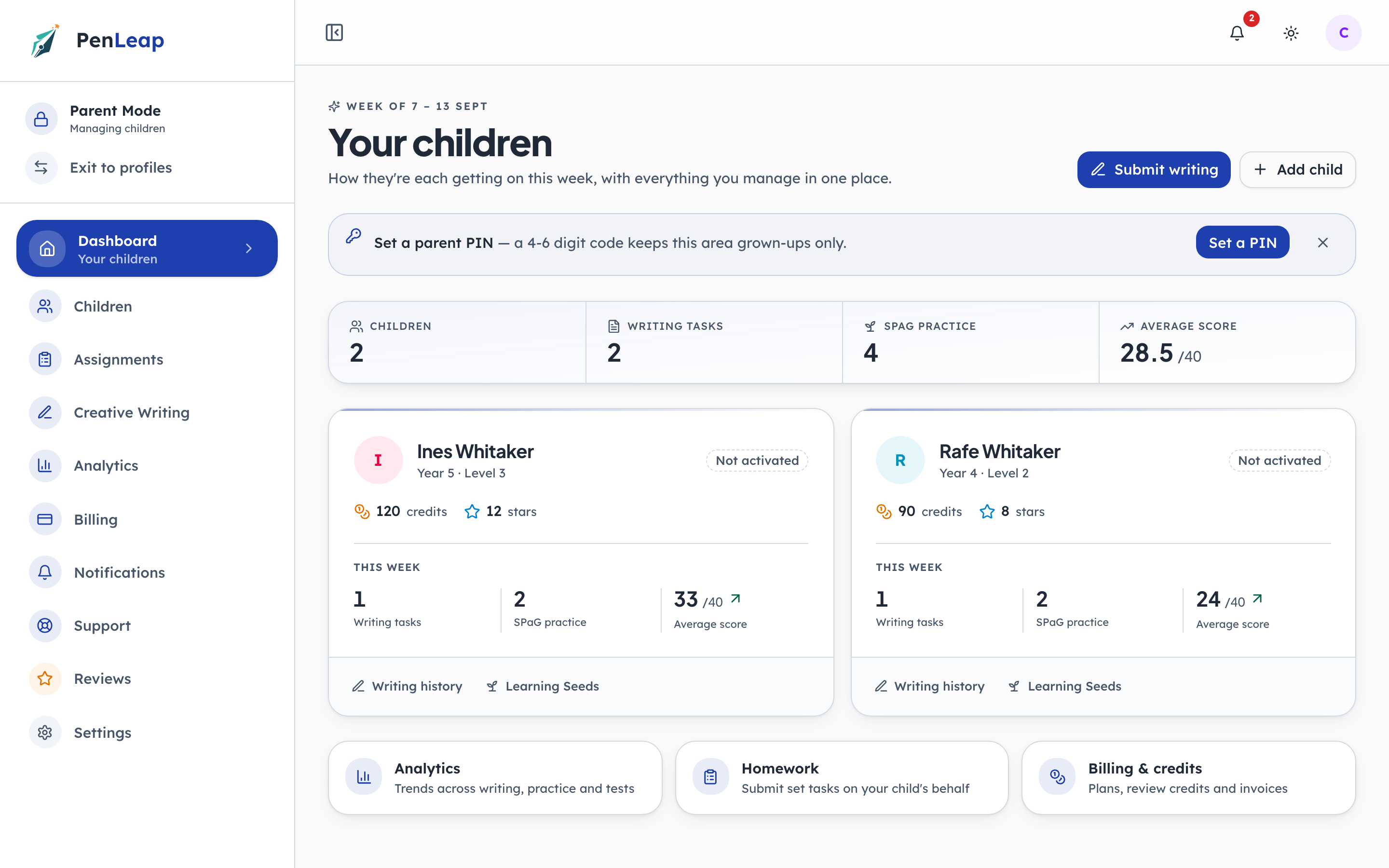
- 1Notice: The second child, same shape
Worth saying out loud because it is a design decision, not an oversight: when a child has done nothing, the card says so and offers the one useful action. It does not manufacture an encouraging number out of logins. A report that always has good news in it is a report nobody reads twice.
The detail behind it
Steps 3–4Parent- penleap.com/parent/analyticsSigned in as Parent
3Five views, one child, one date range 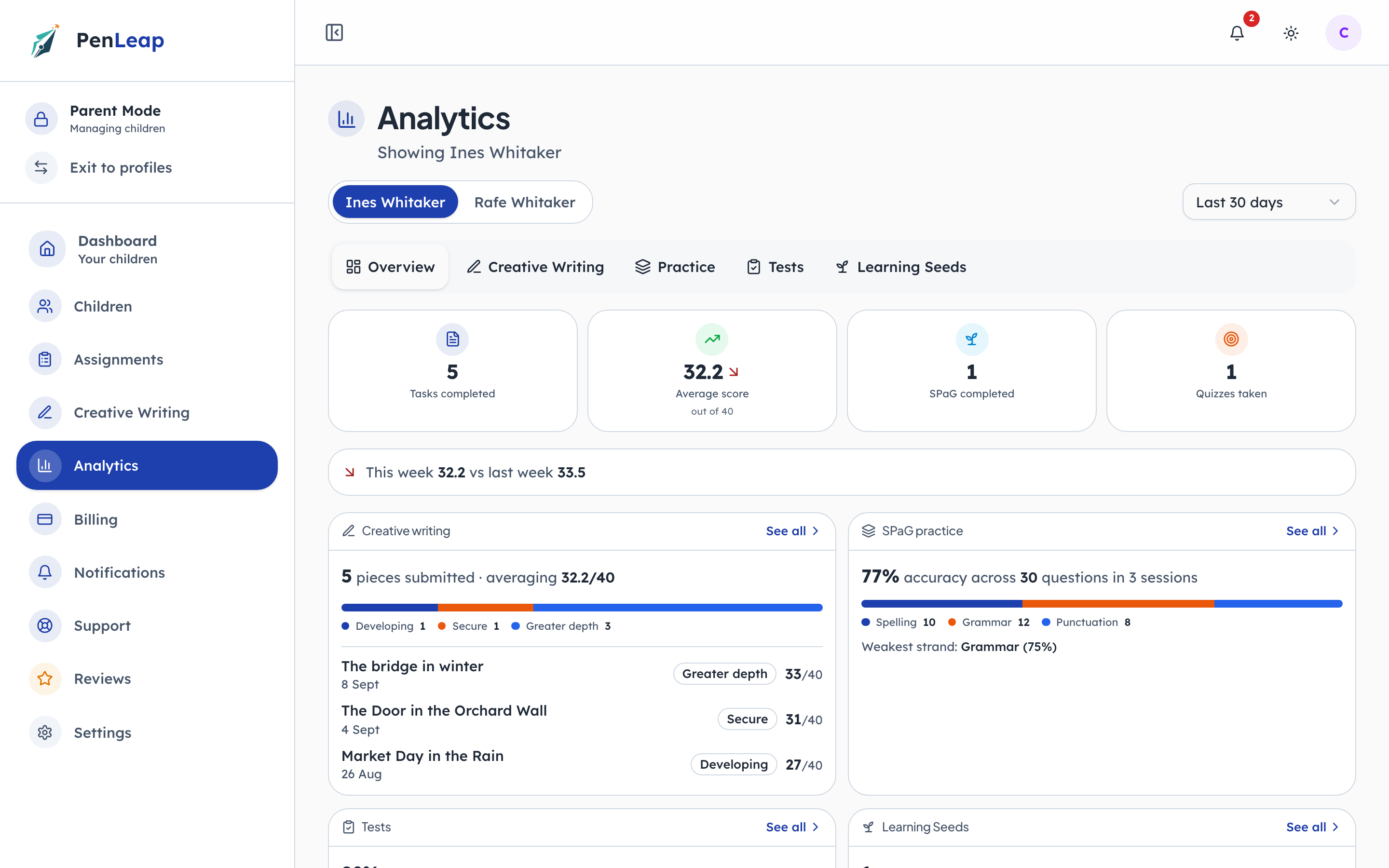
- 1Click: Everything at once
- 2Click: Or one kind of work
- 3Notice: Drills, separately
The child switcher and the date range sit above the tabs rather than inside them, so changing either keeps you where you were. That is the whole reason this is one screen with tabs instead of five pages: a parent comparing two children does not want to re-navigate and re-pick the term each time.
- penleap.com/parent/analyticsSigned in as Parent
4Writing on its own, over whatever period you choose 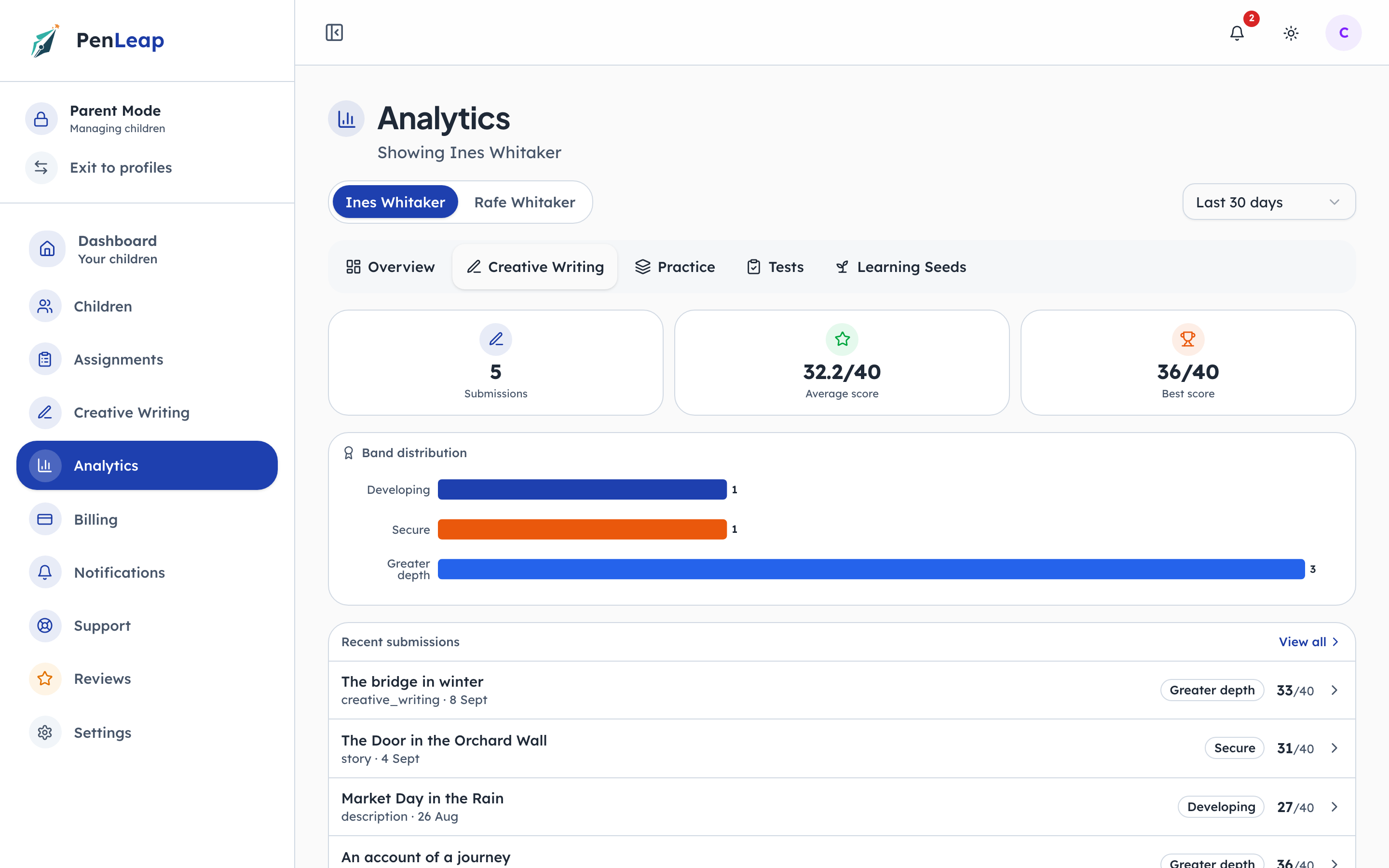
- 1Notice: This tab only
Creative writing is separated from practice on purpose. They move at completely different speeds — a child can do forty drills in a week and one piece of writing — so averaging them together would hide both. A parent worried about writing wants the writing line, not a blended score.
And the writing behind the numbers
Steps 5–6Parent- penleap.com/parent/…/creative-writingSigned in as Parent
5Every piece the centre has published, per child 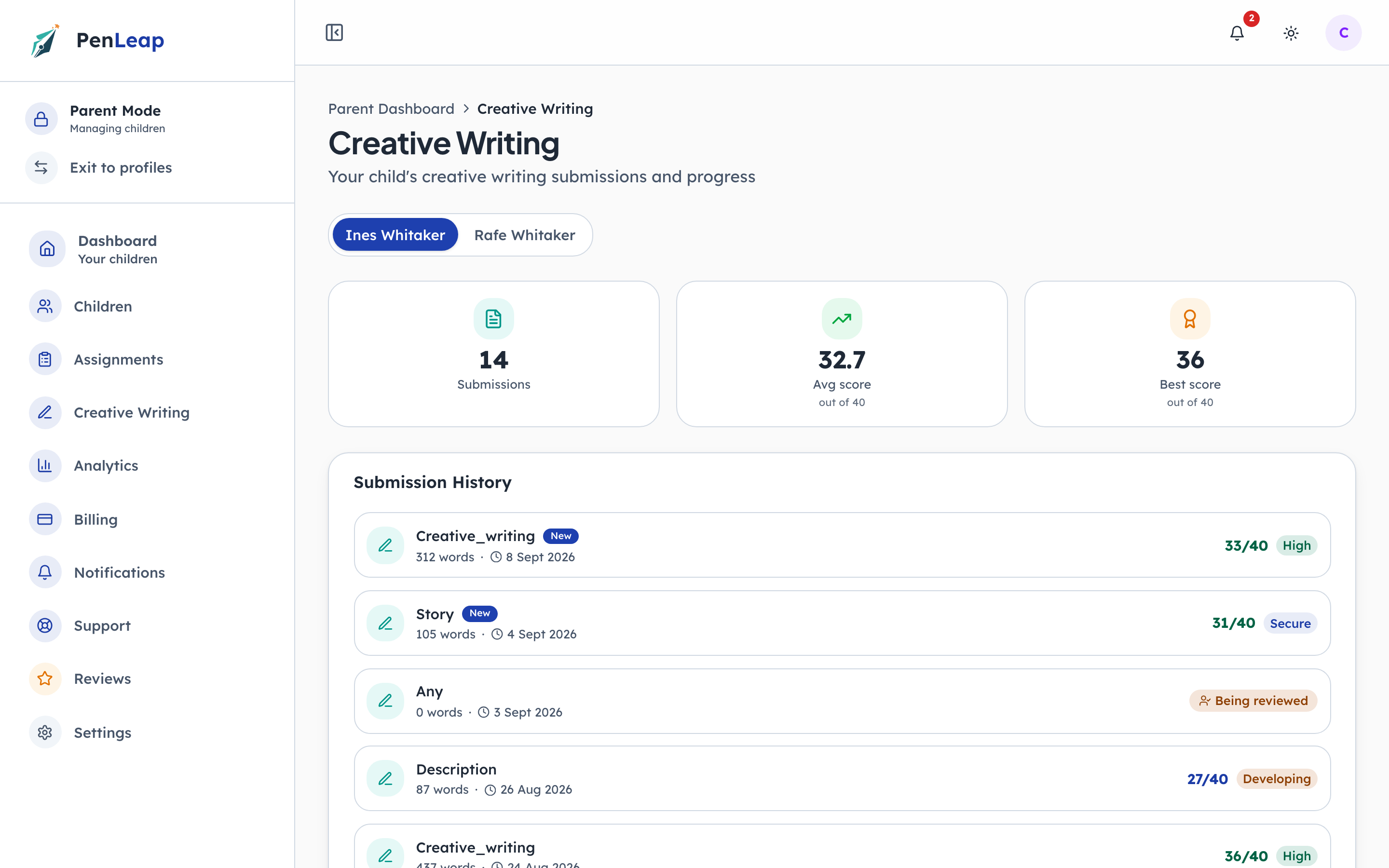
- 1Notice: One child's published work
- 2Notice: Their average
- 3Notice: And their best
Reached from Writing history on the child's card, because this list belongs to one child rather than to the family. Note what is NOT on it: anything the centre has not released. A piece still being marked, or waiting on a second opinion, is invisible here — which is why a parent never reads a mark that is about to change.
- penleap.com/parent/…/creative-writingSigned in as Parent
6Each piece, with the mark it was actually given 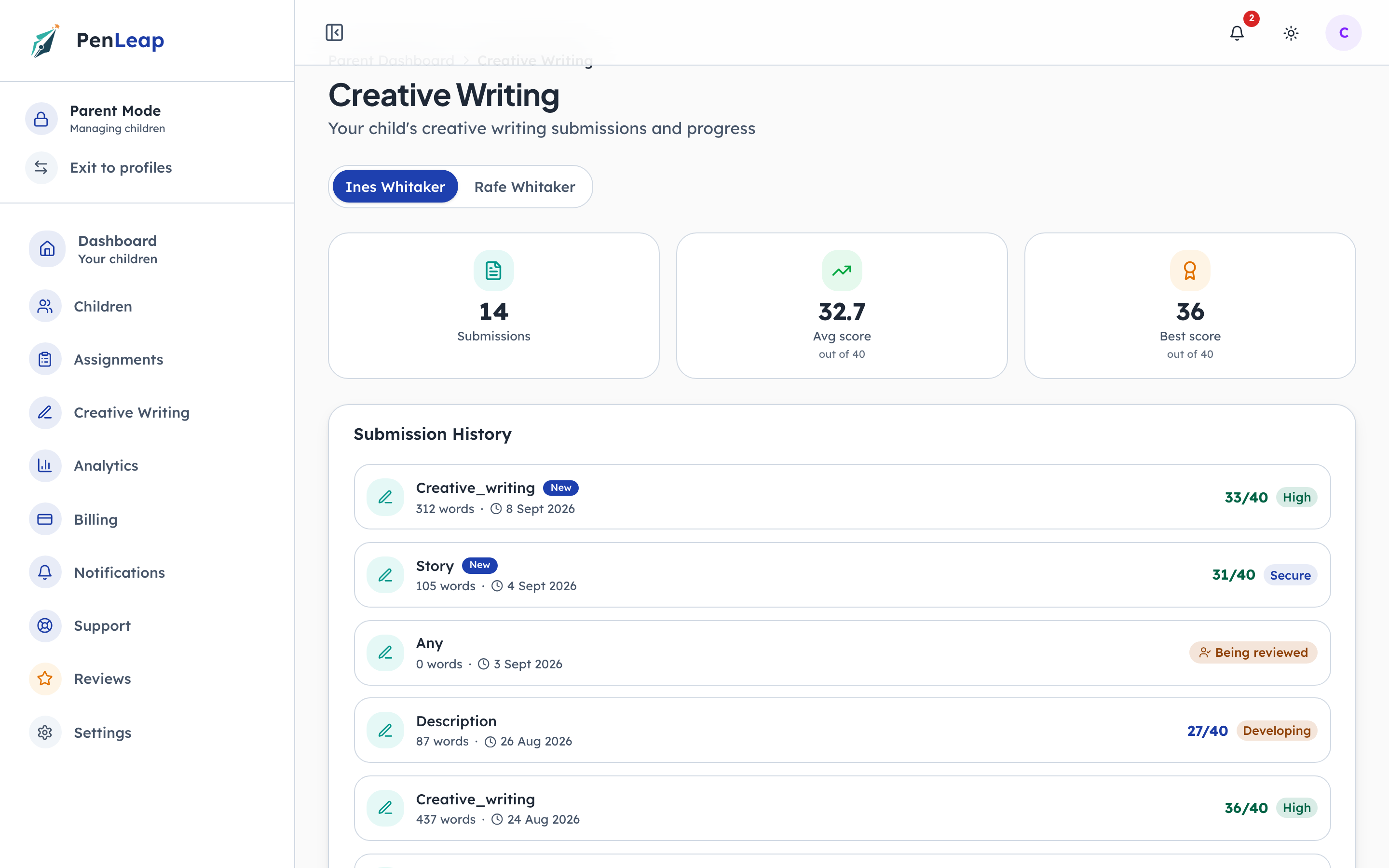
- 1Notice: One row per piece
This list is the evidence behind every figure in the weekly summary. The score is the least useful thing on it: what makes the summary actionable is the marker's annotations underneath, which is how it can say "commas in lists, four times" rather than "punctuation: 62%". One of those can be practised on a Tuesday evening and the other cannot.
The same child, from the centre's side
Step 7Org Admin- penleap.com/dashboard/reports/student/…Signed in as Org Admin
7The same figures, arranged for a different conversation 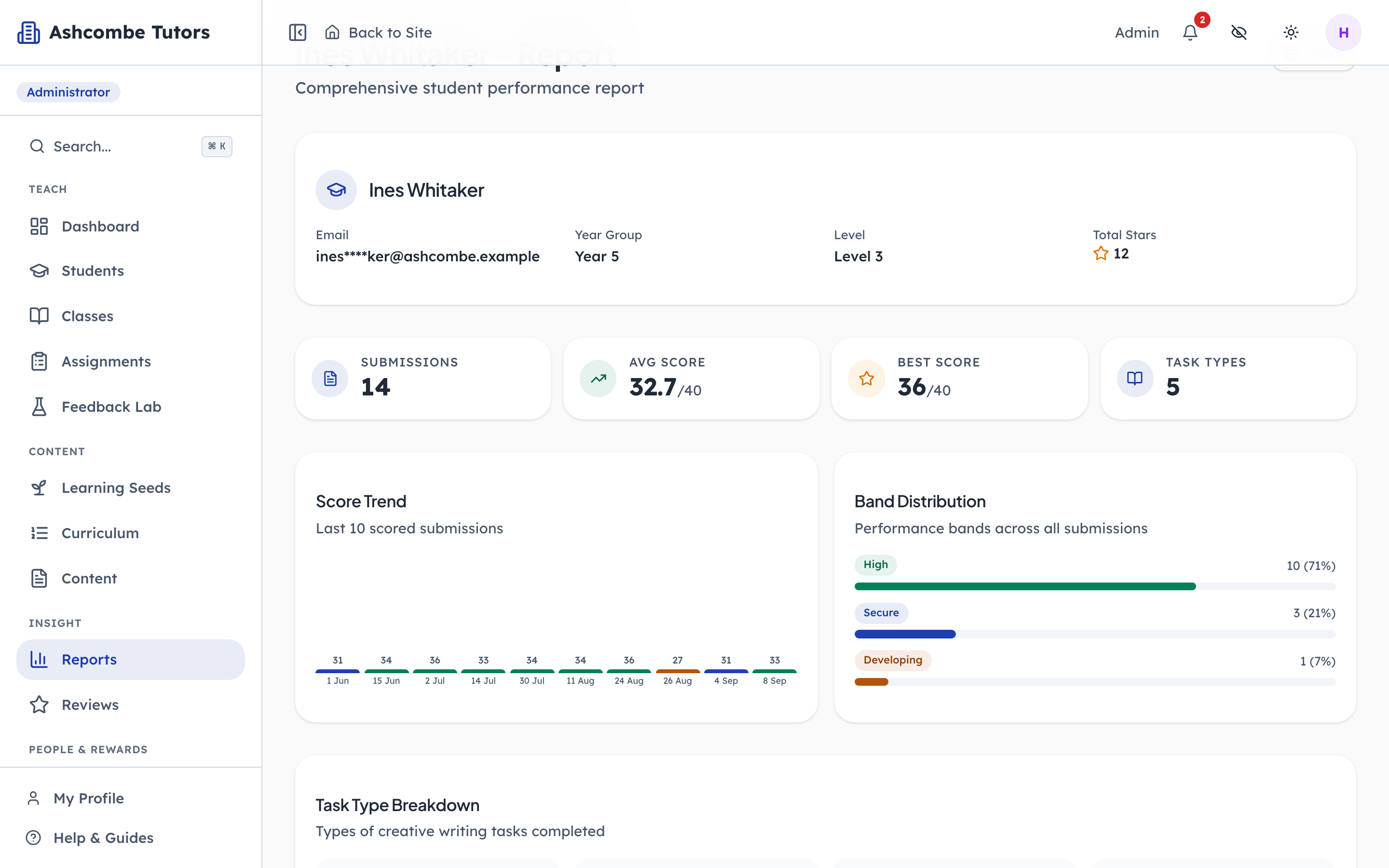
- 1Notice: The same average the parent sees
- 2Notice: The same work, plotted
This is the tutor's view of the child whose parent report opened this walkthrough, and the averages match — because both screens read the same marked submissions rather than each keeping their own tally. It is the reason a parents' evening can be held with both screens open, and the single most important property of the whole reporting system: there is one set of numbers, and everybody is looking at it.